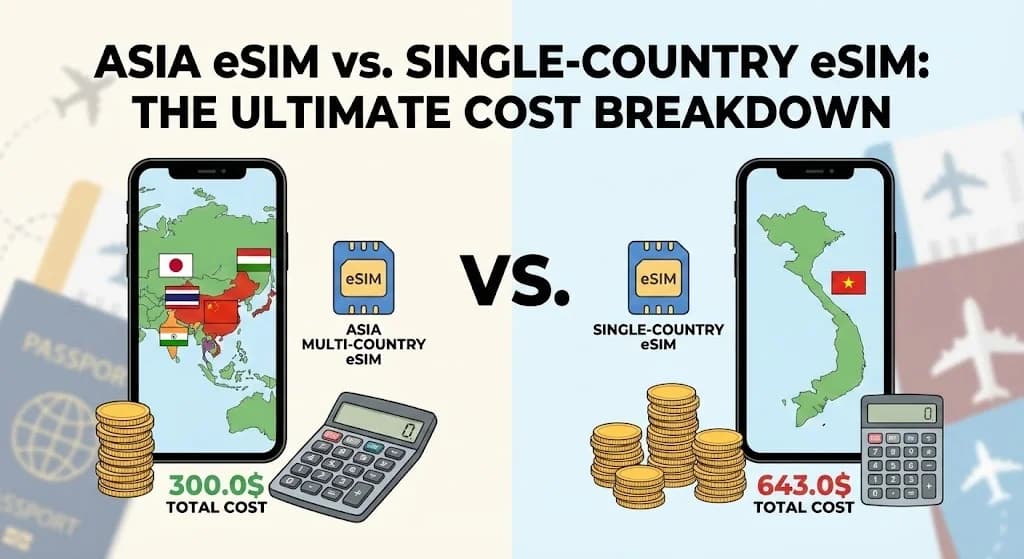
Planning an adventure through Asia often involves a complex itinerary: bustling markets in Thailand, serene temples in Japan, and the futuristic cityscape of Singapore. Amidst the excitement of travel, a crucial question emerges for every modern explorer: how will you stay connected? This pivotal decision often comes down to choosing between a convenient, all-encompassing Asia regional eSIM and purchasing individual eSIMs for each country you visit. The debate over an Asia eSIM versus a single-country eSIM is more than a technicality; it represents a fundamental trade-off between seamless convenience and targeted cost efficiency. Many guides oversimplify this choice, yet the optimal solution hinges entirely on your specific travel style and route. This comprehensive guide will dissect the nuances, offering a clear, data-driven breakdown to help you make an informed decision for your multi-country Asian journey, addressing common concerns about cost, flexibility, and connectivity.
- Understanding Asia Regional eSIMs: Your Multi-Country Pass
- The Case for Single-Country eSIMs: Tailored Connectivity
- Asia eSIM vs. Single-Country eSIM: Quick Comparison
- Cost Breakdown: A Real-World Scenario
- Optimizing Your Data Plan: How Much Data for Asia?
- Activation and Management: Practical Differences
- Beyond Cost: Other Factors for Your Asia eSIM Choice
- Conclusion: Making Your Informed Decision
- Frequently Asked Questions
Connect Across Asia with Cellesim
Experience seamless data in 20+ Asian countries. Join 50,000+ happy customers and simplify your travel connectivity.
View Asia eSIM PlansUnderstanding Asia Regional eSIMs: Your Multi-Country Pass
A regional eSIM acts as a master key for internet access across an entire continent or a large geographical area. With an Asia regional eSIM, you purchase one plan, activate it once, and your phone automatically connects to a partner network as soon as you land in any of the covered countries. This design prioritizes pure, uninterrupted convenience, offering a robust solution for multi-country itineraries.
How an Asia Regional eSIM Functions
Behind the scenes, Cellesim partners with major mobile carriers across numerous Asian countries. For instance, when you arrive at Suvarnabhumi Airport in Bangkok, your eSIM connects to a network like AIS or TrueMove. If your journey then takes you to Singapore, your connection seamlessly switches to Singtel or StarHub, all without any manual intervention on your part. This global roaming capability, facilitated by a single eSIM profile, eliminates the need to buy and activate new data plans at each border crossing. It's an efficient way to manage connectivity across a diverse region like Asia, especially for complex itineraries involving several countries.
The Advantages of a Regional Asia eSIM
- Unmatched Convenience: Install your eSIM once before departure. There is no need to hunt for local SIM cards or rely on insecure public Wi-Fi to activate new plans after a long flight. You land, disable airplane mode, and you are online.
- Seamless Border Crossings: Avoid data gaps when moving between countries. Your connection remains active, allowing continuous access to maps, ride-sharing apps, and communication tools.
- Simplified Budgeting: One upfront cost covers data for all included countries, making it easier to manage your travel expenses without unexpected charges.
- Ideal for Whirlwind Tours: If your itinerary involves several short stays in multiple countries (e.g., 3+ countries in a short period), the time saved on managing individual eSIMs becomes significant.
The Case for Single-Country eSIMs: Tailored Connectivity
In contrast to regional plans, a single-country eSIM is purchased and activated specifically for one nation. This approach offers a different set of benefits, particularly appealing to travelers with longer stays, specific data needs, or a focus on minimizing costs in individual destinations.
How Individual Country eSIMs Work
When you opt for a single-country eSIM, you acquire a data plan tailored exclusively for use within that particular country's borders. For example, a Japan eSIM will only provide data services while you are physically in Japan. Upon crossing into another country, like South Korea, you would need to activate a separate South Korea eSIM. This method gives you granular control over your connectivity, allowing you to select specific local providers and plans.
The Benefits of Single-Country eSIMs for Asia Travel
- Optimized Cost for Specific Countries: In countries where local data is particularly inexpensive, a single-country eSIM can often provide more data for less money compared to an averaged regional plan. This is especially true for longer stays.
- Larger Data Allowances: Local plans often come with more generous data caps, or even "unlimited" options (though actual usage limits may apply), catering to heavy data users.
- Stronger Local Network Priority: While regional eSIMs offer excellent coverage, a local eSIM might provide slightly better network priority or access to specific local benefits that roaming agreements sometimes exclude.
- Flexibility in Plan Duration: You can choose plans that perfectly match your stay duration in each country, avoiding paying for unused data days in a regional package.
"For my three-week backpacking trip through Vietnam and Cambodia, using individual eSIMs was cheaper and gave me more data than any regional plan I found. It required a bit more planning, but the savings were worth it."
Asia eSIM vs. Single-Country eSIM: Quick Comparison
To help visualize the fundamental differences, here is a concise comparison focusing on the key decision-making factors for your Asia trip.
| Feature | Asia Regional eSIM | Single-Country eSIM |
|---|---|---|
| Convenience | Seamless activation, one plan for all countries. | Requires activation per country. |
| Cost Efficiency | Good for high-cost countries, balances overall price. | Best for low-cost countries, maximizes local value. |
| Network Handoffs | Automatic, no data gaps at borders. | Connection drops, requires new activation per country. |
| Data Pool | One large pool for the entire regional trip. | Tailored data size and duration per country. |
| Best For | Fast-paced tours (3+ countries), business travel, first-time eSIM users. | Backpackers, slow travelers, budget-focused trips. |
Cost Breakdown: A Real-World Scenario
The "ultimate cost breakdown" isn't a fixed price but rather a calculation based on your itinerary. Let's consider a hypothetical 15-day trip through Asia, visiting Thailand (5 days), Singapore (3 days), and Japan (7 days).
Scenario A: Cellesim Asia Regional eSIM (20 Countries)
For a 15-day trip covering 20 countries in Asia, including Thailand, Singapore, and Japan, Cellesim offers plans like 10GB for 30 days. Let's assume a plan costs around $25-$30 for 10GB.
- Total Cost: ~$28 (for 10GB / 30 days)
- Average Daily Cost: ~$1.87 per day
- Pros: Zero hassle, guaranteed connectivity across all three countries with one purchase.
- Cons: If you only use 5GB, you've paid for more than you needed. If you run out of data, top-ups might be at the standard regional rate.
Scenario B: Individual Cellesim Single-Country eSIMs
Let's estimate typical Cellesim single-country prices for a comparable data amount (e.g., 3-5GB per country for typical use):
- Thailand (5 days): A 5GB plan might cost around $10.
- Singapore (3 days): A 3GB plan might cost around $8.
- Japan (7 days): A 5GB plan might cost around $15.
- Total Estimated Cost: $10 + $8 + $15 = $33
- Average Daily Cost: ~$2.20 per day
- Pros: Potentially more data for your money in some specific countries, or the ability to buy exactly what you need for each leg.
- Cons: Requires three separate purchases and activations. You'll experience a brief data interruption when crossing borders.
Optimizing Your Data Plan: How Much Data for Asia?
Understanding your data usage is crucial for selecting the most cost-effective eSIM. Whether you choose a regional or single-country plan, overbuying or underbuying data can lead to unnecessary costs or connectivity issues.
Typical Data Consumption for Travelers
- Light User (1-2GB per week): Primarily uses WhatsApp/messaging, light web browsing, occasional map checks, email.
- Moderate User (3-5GB per week): Includes social media, moderate map navigation, some video streaming, occasional video calls.
- Heavy User (5-10GB+ per week): Frequent video streaming, extensive social media, regular video calls, hotspot usage, downloading content.
For a multi-country Asia trip, consider your daily habits. Are you primarily using hotel Wi-Fi, or will you be relying heavily on mobile data for navigation, research, and communication throughout the day? The Cellesim Smart Data Calculator can help you estimate your needs based on your planned activities.
Activation and Management: Practical Differences
The operational aspects of setting up and managing your eSIM are key to a stress-free experience, particularly when traveling across multiple Asian nations.
Activating a Regional Asia eSIM
The process is straightforward: purchase your Asia eSIM online from Cellesim. You'll receive an email with a QR code or manual installation details. Scan the QR code on your eSIM-compatible device (check eSIM compatible devices) before you depart. Once installed, the eSIM remains active for the duration and data allowance you've chosen, connecting automatically to local networks as you enter covered countries. This "set it and forget it" approach minimizes stress during travel.
For a detailed guide, refer to our complete eSIM setup guide.
Managing Single-Country eSIMs
If you opt for individual eSIMs, you will repeat the purchase and activation process for each new country. While still digital and relatively quick, this involves more steps:
- Research and purchase the specific country eSIM (e.g., Thailand eSIM, Vietnam eSIM) before or upon arrival.
- Scan the QR code or manually install each new eSIM profile.
- Switch between active eSIM profiles in your phone settings as you cross borders.
This method offers greater control and customization per country but demands more active management from the traveler. While generally simple, delays can occur if you face issues with activation or need to troubleshoot in a new country.
Find Your Perfect Asia eSIM
Beyond Cost: Other Factors for Your Asia eSIM Choice
While cost is often a primary consideration, several other factors can influence the ideal choice between an Asia regional eSIM and multiple single-country eSIMs.
Trip Duration and Pace
- Short, Fast-Paced Trips (e.g., 1-2 weeks, 3+ countries): Regional eSIMs shine here due to their convenience and seamless transitions. The time saved managing multiple plans is valuable.
- Longer, Slow-Paced Trips (e.g., 3+ weeks, 1-2 countries): Single-country eSIMs become more attractive. The potential cost savings and larger data allowances for extended stays in a single location can outweigh the setup effort. This is particularly relevant for choosing the perfect eSIM plan based on trip length.
Your Travel Style and Priorities
- Convenience-Oriented Traveler: If you prioritize simplicity, minimal fuss, and uninterrupted connectivity above all else, an Asia regional eSIM is likely your best fit.
- Budget-Conscious Traveler: If you are meticulous about saving every dollar and are willing to invest a little more time in research and management, single-country eSIMs may offer greater control over your budget.
- Business Traveler: For those on a tight schedule who cannot afford connectivity interruptions, a regional eSIM provides reliability across multiple meeting locations.
Coverage and Network Quality
Both regional and single-country eSIMs leverage local networks, but checking the specific coverage maps of the primary carriers in your destination countries is always advisable. Reputable eSIM providers like Cellesim partner with leading networks to ensure robust 4G/5G connectivity. You can often find network information on the respective tourism board websites or telecom regulator sites like ITU Telecom Regulatory Profiles.
Conclusion: Making Your Informed Decision
The choice between an Asia regional eSIM and multiple single-country eSIMs is a personal one, with neither option being universally superior. It depends directly on your travel priorities, itinerary, and budget constraints. If seamless convenience, minimal management, and broad coverage across numerous destinations are your primary concerns for a faster-paced trip, a Cellesim Asia regional eSIM is likely your optimal solution. It simplifies connectivity, allowing you to focus on the experience.
Conversely, if your journey involves longer stays in specific, often budget-friendly countries, and you prioritize maximizing data allowance for the lowest possible cost per gigabyte, then individual single-country eSIMs could offer greater value. This approach requires more active management, but it delivers tailored connectivity. By carefully considering your travel style, understanding the cost implications, and leveraging tools like the Cellesim Smart Data Calculator, you can select the perfect eSIM strategy for your upcoming Asian adventure, ensuring you stay connected on your terms.
Ready for Seamless Connectivity in Asia?
Choose Cellesim for reliable, high-speed data across 20+ Asian countries. Set up in minutes.
Explore Asia eSIM PlansTrusted by 50,000+ travelers worldwide. 24/7 Support: [email protected]
Frequently Asked Questions
Is an Asia eSIM cheaper than buying individual country eSIMs?
Not always. For short, multi-country trips, an Asia regional eSIM can be more cost-effective due to convenience. However, for longer stays in countries with very cheap local data, individual country eSIMs might offer more data for less money. It depends on your specific itinerary and data needs.
Which countries are usually covered by an Asia regional eSIM?
Cellesim's Asia regional eSIM covers 20 countries, including popular destinations like Thailand, Japan, South Korea, Singapore, Vietnam, Cambodia, Malaysia, and more. Always check the specific country list before purchasing to ensure all your destinations are included.
Can I use my existing phone number with an eSIM?
Yes, you can absolutely keep your primary phone number active for calls and texts while using a data-only travel eSIM for internet access. This is a common setup for travelers to avoid roaming charges for data while still receiving important calls/texts on their original number.
Do Asia eSIMs offer 5G connectivity?
Most modern regional and single-country eSIMs from providers like Cellesim support 4G LTE and often 5G connectivity where available in the local network. Performance depends on the local network infrastructure and your device's capabilities.
When should I activate my Asia eSIM?
It is recommended to activate your Cellesim eSIM before you travel, ideally while you still have a stable internet connection. You can install it at home, and the data plan will typically only start counting down once it connects to a network in the destination country. This ensures you're connected as soon as you land.
What if I run out of data on my Asia eSIM?
If you deplete your data allowance on a Cellesim eSIM, you can easily purchase a top-up directly from your Cellesim account. This process is quick and allows you to add more data to your existing eSIM profile without needing to install a new one.