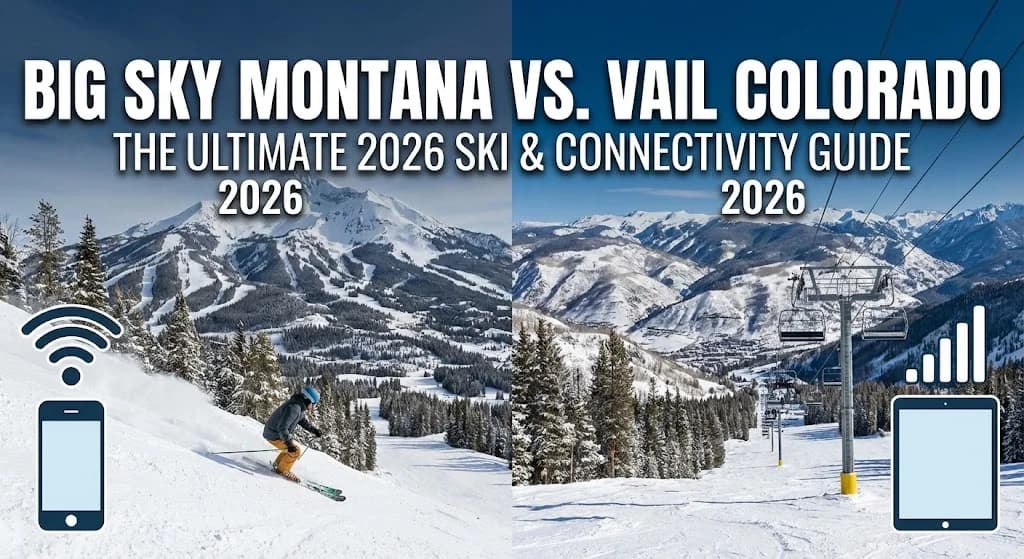
The plane's wheels touch down, and that familiar chime signals your arrival. You've just landed at either Denver International (DEN) for a trip to Vail, or the more intimate Bozeman Yellowstone (BZN) for Big Sky. Your first priority isn't the crisp mountain air; it's your phone. You need to check the shuttle confirmation, pull up a map for your rental car, and let your family know you've arrived safely. Every international traveler faces this exact connectivity moment.
Will you hunt for weak, insecure airport WiFi? Face exorbitant roaming charges from your home carrier? Or did you plan ahead? The debate of Big Sky vs. Vail Colorado for your 2026 ski vacation involves more than just slopes and snow. It's about ensuring your trip is easy and connected from the second you land. For most international visitors, reliable mobile data is essential, and an eSIM for USA travel is the smartest way to get it. This guide will help you pick the right mountain and the right way to stay connected throughout your adventure.
- Big Sky vs. Vail: The Ultimate 2026 Ski Experience
- Connectivity Challenges in the Rocky Mountains for Skiers
- Why an eSIM is Your Essential Ski Companion
- Choosing the Right Cellesim eSIM Plan for Your Ski Trip
- Network Coverage & Performance in Big Sky and Vail
- Cost-Effective Connectivity: eSIM vs. Traditional Options
- Pro Tips for a Seamlessly Connected Ski Vacation
- Frequently Asked Questions
Stay Connected in the USA
Get instant data on arrival for your Vail or Big Sky trip. Choose a flexible, high-speed plan and avoid roaming fees. Join 50,000+ happy customers.
Shop USA eSIM Plans ⚡Big Sky vs. Vail: The Ultimate 2026 Ski Experience
Planning a ski trip to the Rockies in 2026 means picking between two legendary places: Big Sky, Montana, and Vail, Colorado. Each resort offers a distinct experience, suiting different tastes for terrain, atmosphere, and amenities. Knowing these differences is key to an amazing vacation.
Big Sky, often called "Biggest Skiing in America," offers huge, rugged terrain with over 5,850 acres of skiable land and a vertical drop exceeding 4,350 feet. It's famous for uncrowded slopes, diverse trails from easy cruisers to tough expert runs, and access to the iconic Big Couloir. The vibe here is more relaxed, rustic, and focused on the wilderness, perfect for those who put skiing above all else. For 2026, Big Sky keeps investing in lifts and base area improvements, making it easier to get around its vast terrain.
Vail, on the other hand, means luxury, world-class amenities, and its famous Back Bowls. With 5,317 acres, Vail delivers a meticulously groomed experience, high-speed lifts, and an extensive network of diverse trails. The pedestrian villages of Vail and Lionshead feel like a European alpine town, with high-end dining, shopping, and lively après-ski scenes. Vail's 2026 season is expected to uphold its reputation as a top destination, with ongoing efforts to improve guest flow and the on-mountain experience.
Your choice often comes down to what you prioritize. If you want huge, uncrowded terrain and a more authentic mountain town feel, Big Sky might be for you. If luxury, extensive amenities, and a lively village atmosphere are higher on your list, Vail delivers.
Connectivity Challenges in the Rocky Mountains for Skiers
No matter which destination you choose, staying connected in the Rocky Mountains has its unique challenges. Both Big Sky and Vail, despite their popularity, are in mountainous regions where cell service can be spotty.
In Big Sky, the challenge comes from its relative remoteness. While the base areas and main lifts usually have good coverage, heading into some of the expansive glades or more distant trails can mean losing signal. This is especially important for safety, as GPS, emergency calls, or coordinating with ski partners become vital. Hikers and backcountry skiers venturing beyond resort boundaries will find even less coverage.
Vail, being a more developed resort with bigger infrastructure, generally offers more consistent connectivity within its main villages and on most groomed trails. However, its immense Back Bowls, especially on powder days, can still have weaker signals. Imagine needing to look up directions to a restaurant in Vail Village or check the latest snow report, only to find yourself without data. For international travelers, getting around on public transport, translating menus, or simply staying in touch with home all demand a reliable data connection.
A reliable data connection isn't just about convenience; it's about safety. Access to weather updates, avalanche forecasts, emergency services, and communication with travel companions is crucial in a mountain environment. This is why a pre-arranged, solid connectivity solution is essential.
Why an eSIM is Your Essential Ski Companion
When thinking about mobile data for your 2026 ski trip to the USA, an eSIM stands out as the most convenient and budget-friendly option for international visitors. Unlike traditional physical SIM cards, an eSIM is built right into your compatible smartphone, letting you download and activate a data plan digitally.
The main benefit for skiers is instant connectivity the moment you arrive. Instead of looking for local SIM card sellers at the airport after a long flight, you can buy and install a Cellesim USA eSIM plan before you even leave home. This means you'll have active data as soon as your plane lands, ready to navigate to your accommodation, check weather forecasts, or connect with friends on the mountain.
Plus, an eSIM means you don't have to fuss with swapping physical SIM cards, which can easily get lost in cold, snowy conditions. You can keep your home SIM card active for calls and texts (but watch out for roaming charges for these) while using the eSIM for all your data needs. This dual-SIM ability is particularly helpful for business travelers or anyone who needs to keep their primary number.
Cellesim offers flexible data packages for different trip lengths and data needs. This means you only pay for what you use, avoiding the often very expensive daily roaming fees from your home carrier. For a full explanation of how eSIMs simplify travel, check out our Complete eSIM Setup Guide.
Choosing the Right Cellesim eSIM Plan for Your Ski Trip
Picking the right data plan for your Big Sky or Vail adventure is crucial for staying connected without interruption. Your data needs on a ski trip can change a lot based on what you do and how you use your phone.
Think about your typical daily usage:
- Light User (1-3 GB for 7 days): Mostly checking maps, weather apps, occasional messages (WhatsApp, iMessage), and light social media.
- Moderate User (5-10 GB for 7-14 days): Regular social media updates (photos/videos), streaming music on the lifts, video calls with family, using navigation apps a lot, checking resort webcams.
- Heavy User (15-20+ GB for 14+ days): Frequent video streaming, uploading high-quality videos of your runs, using your phone as a hotspot for a laptop, or if you're a business traveler needing constant connection.
For a ski trip, reliable data for navigation and communication is key. Apps like Strava, Ski Tracks, or the resort's official app can use data for GPS tracking. Social media, especially with photo and video uploads from the slopes, will use a lot of data. Cellesim offers various USA eSIM plans, including options with plenty of data for a typical week-long or two-week ski vacation. If you're not sure, Cellesim's Smart Data Calculator can help you guess what you'll need.
A Quick Guide to Activating Your Cellesim eSIM:
- Check Compatibility: Make sure your device supports eSIM. Use our eSIM Checker.
- Purchase Your Plan: Visit cellesim.com, pick your desired USA eSIM plan, and complete the purchase. You'll get a QR code or manual installation details by email.
- Install the eSIM: Follow the instructions to add the eSIM to your device's cellular settings. This usually means scanning the QR code. You can do this before you travel, at home.
- Activate on Arrival: Once you land in the USA, turn on your Cellesim eSIM for data in your phone's settings. Make sure data roaming is off for your primary SIM to avoid unexpected charges. For a detailed guide, check out our Interactive Setup Guide.
Network Coverage & Performance in Big Sky and Vail
Understanding network coverage is vital for a smooth connected experience at mountain resorts. Cellesim works with major local networks in the USA to provide strong coverage, typically using AT&T and T-Mobile infrastructure.
In Vail, Colorado, because of its established infrastructure and higher population density in the valley, you can generally expect good 4G LTE and increasingly 5G coverage within the villages of Vail and Lionshead. On the main ski trails and frontside bowls, connectivity is usually strong. However, in the vast areas of the Back Bowls or more remote parts of the resort, signal strength can vary. Major US carriers have invested a lot in this region, but dense forests and deep valleys will always make it challenging.
For Big Sky, Montana, the landscape is more rugged and less developed outside the resort's core. While the Mountain Village and the primary lifts offer good 4G LTE coverage, areas further out, especially towards Moonlight Basin or some of the more advanced terrain, can have patchy service. Given Big Sky's reputation for extensive, wild terrain, having a reliable connection for navigation or emergencies is even more critical. Travelers here should be ready for potential dead zones in the most remote areas.
It's always a good idea to check up-to-date coverage maps from major US carriers like AT&T or T-Mobile (which Cellesim uses) before your trip. For example, OpenSignal or Ookla's Speedtest map can provide real-world user data on network performance in specific regions. Check OpenSignal's network coverage maps for the latest information.
Cost-Effective Connectivity: eSIM vs. Traditional Options
When traveling to ski destinations like Big Sky or Vail, you have several choices for mobile data, but their costs and convenience differ significantly. Let's compare eSIM with traditional roaming and local physical SIM cards.
| Option | Convenience | Cost (per day avg.) | Network Access | Setup Time |
|---|---|---|---|---|
| Cellesim eSIM | High | From $2-5 | Full 4G/5G Local | Minutes |
| Carrier Roaming | High (automatic) | $10-15+ | Limited (partner networks) | Instant (pre-existing) |
| Local Physical SIM | Moderate | $3-7 | Full 4G/5G Local | Hours (store visit) |
Carrier Roaming: While convenient because it works automatically, roaming is almost always the most expensive option. Daily passes quickly add up, turning a week-long trip into hundreds of dollars just for basic data. For skiers, this means hesitating to check snow reports or share photos due to cost.
Local Physical SIM: This can be a more affordable option, but it requires finding a local mobile store, buying a SIM, and possibly dealing with language barriers or activation problems. This eats into valuable ski time when you arrive, and you might need to swap out your home SIM, risking loss. This process is generally less suitable for short trips or those who want immediate connectivity. You can learn more about this in our Airport SIM vs. eSIM comparison.
Cellesim eSIM: Offers the best of both worlds. It provides the convenience of instant setup before you travel, removes the need for physical SIM swapping, and offers significantly lower costs compared to roaming, often competitive with or even cheaper than local SIMs, without the hassle. It truly is the most practical choice for an easy, connected ski trip in 2026.
Pro Tips for a Seamlessly Connected Ski Vacation
To get the most out of your connectivity and your ski trip, keep these practical tips in mind:
- Offline Content: Download movies, podcasts, or music before heading to the mountains. Even with good data, you might hit slow speeds or dead spots, especially on crowded chairlifts or in remote areas.
- Battery Life: Cold weather drains phone batteries faster. Always carry a portable power bank, especially when spending a full day on the slopes. Using GPS tracking apps for skiing also uses a lot of power.
- Monitor Data Usage: Keep an eye on your data consumption through your phone settings or the Cellesim website. This helps you avoid running out unexpectedly. If you need it, topping up your Cellesim eSIM is simple. Read more on how to check eSIM data usage and top up.
- Utilize Wi-Fi: When available at your hotel, lodge, or restaurants in Vail or Big Sky, connect to Wi-Fi to save your eSIM data for when you really need it on the go.
- Keep Your Number Active: Cellesim eSIMs mainly provide data. You can keep your primary physical SIM active to get calls and texts, but use Wi-Fi or data-based apps like WhatsApp, FaceTime, or Messenger for communication to avoid roaming charges. Discover more about keeping your number with an eSIM.
- Emergency Preparedness: Even with a great eSIM, mountain environments are unpredictable. Tell someone your plans if you're venturing into the backcountry, and know the local emergency numbers (911 in the USA). The official resort apps for Vail (Vail App) and Big Sky (Big Sky App) often include mountain maps and emergency contacts.
By combining the thrill of Big Sky's vastness or Vail's luxury with smart connectivity from Cellesim, your 2026 ski adventure will be easy, safe, and unforgettable.
Ready for Seamless Connectivity on Your Ski Trip?
Don't let connectivity worries interrupt your mountain adventure. Get your Cellesim USA eSIM today.
Start Your Connected JourneyTrusted by 50,000+ travelers worldwide. 24/7 Support: [email protected]
Big Sky vs. Vail: A Skier's Quick Comparison
Before getting into the details of mobile data, let's talk about the main reason for your trip: the skiing. Choosing between these two giants of the American Rockies really depends on your priorities, who you're traveling with, and your budget. They offer very different experiences, and understanding them is key to a great vacation.
The Vibe and Terrain: Vail's Legendary Back Bowls vs. Big Sky's Lone Peak
Vail, Colorado, is the polished, world-famous mega-resort. It boasts 5,317 acres of skiable terrain, famously including its seven legendary Back Bowls. The vibe is luxurious and busy, with a European-style pedestrian village full of high-end shops, fine dining, and a lively après-ski scene. The mountain is perfectly groomed, and the lift system is one of the most efficient globally. It’s an incredible experience, but it comes with crowds, especially during peak season. In contrast, Big Sky, Montana, offers a wilder, more rugged experience. At 5,850 acres, it's technically larger and centered around the impressive Lone Peak. The terrain here is vast, challenging, and feels untamed. The motto "Biggest Skiing in America" isn't just marketing; you can ski all day and rarely repeat a run. The atmosphere is more relaxed, a classic Western mountain town vibe that prioritizes the skiing itself over glitz and glamour.
For the Family: Which is Better for Families, Big Sky or Vail?
When it comes to family travel, both resorts are excellent in different ways. Vail is exceptionally family-friendly thanks to its world-class ski school, many non-skiing activities (ice skating, tubing), and a village that is entirely walkable, making it easy to get around with kids. The variety of terrain ensures there are plenty of green and blue runs for beginners and intermediates. Big Sky is also great for families, but with a different focus. Its sheer size means fewer crowded slopes, giving learners more space. The Mountain Village is more contained, and many lodging options are ski-in/ski-out, which is a huge convenience. However, off-mountain activities are less plentiful than in Vail, making it a better fit for families who are purely focused on skiing and snowboarding. For more family travel tips, consider exploring a dedicated eSIM for family travel.
The Cost Breakdown: Cost of Skiing in Vail vs Big Sky
Let's be clear: both destinations are premium and a big investment. However, there's a clear difference. Vail is consistently ranked as one of the most expensive ski resorts in North America, while Big Sky generally offers better value. The table below shows typical cost differences for a week-long trip.
| Cost Factor | Vail, Colorado (Approx.) | Big Sky, Montana (Approx.) |
|---|---|---|
| Single-day lift ticket | Over $250 | $180 - $220 |
| Standard lodging (per night) | $800+ | $400 - $700 |
| Family of 4 (7-day trip, est.) | $8,000 - $12,000+ | $6,000 - $10,000 |
| Average Daily Food Cost | $150+ per person | $100 - $130 per person |
| Cellesim eSIM Data | From $25 (for 10GB / 15 days) | From $25 (for 10GB / 15 days) |
A family of four could realistically save over $1,000 on a week-long trip by choosing Big Sky over Vail, without sacrificing ski quality. These figures don't include airfare, rentals, or lessons, which also add significantly to the total budget. For exact pricing, always check the official resort websites, such as Vail.com and BigSkyResort.com.
The Connectivity Challenge: Staying Online in the Rocky Mountains
Now, let's turn to a crucial, often overlooked part of your trip: staying connected. Whether you're coordinating with your group on the mountain, checking real-time lift status on the EpicMix app in Vail, or navigating the remote roads around Big Sky, reliable mobile data is a must-have. International travelers have several options, but most come with significant downsides.
Why Your Home Plan's International Roaming is a Bad Idea in the USA
The easiest option is often the most expensive. Using your home carrier's international roaming plan in the USA can be financially painful. Many providers from Europe, Asia, or Australia charge daily fees that quickly add up. A typical plan might cost €7-€10 or £6 per day. For a 10-day ski trip, you could be looking at an extra $100+ on your phone bill for a very limited amount of data. In my experience, these roaming packages often come with throttled speeds, meaning your connection will be frustratingly slow right when you need it most. It’s a convenience that comes at a very high price.
The Reality of Airport WiFi and Public Hotspots
Relying on free WiFi is a risky strategy. While Denver (DEN) and Bozeman (BZN) airports offer free WiFi, it's often slow and unsecured, which isn't ideal for sensitive information like booking confirmations or banking apps. Once you leave the airport, you're on your own. Your hotel will have WiFi, but what about on the shuttle bus, in the grocery store, or most importantly, on the vast expanse of a mountain? Public WiFi is sporadic and unreliable. You can't depend on it for navigating with Google Maps or making an emergency call via WhatsApp, making it an impractical main solution for staying connected while traveling. Moreover, consider the implications if you need to compare airport SIM card prices vs. eSIM options before committing.
How to Get Cell Service in Big Sky, Montana: A Special Case
Connectivity in Vail is generally strong, with good signals from major carriers like AT&T, Verizon, and T-Mobile throughout the resort. Big Sky is a different story. Due to its remote location in Montana, cell service can be patchy. While coverage in the main Mountain Village and base area is decent, it can quickly drop off as you explore more remote parts of the mountain or drive in the surrounding Gallatin National Forest. Verizon and AT&T historically have the most reliable networks in this region. This is where your choice of connectivity becomes critical; you need a solution that can use the strongest available local network, not one that's tied to a single roaming partner. For specific coverage maps, you can consult resources like OpenSignal.
Your Four Main Options for Mobile Data in the USA
As an international traveler, you have four ways to get online. Let's break down the pros and cons of each, especially for a ski trip to Colorado or Montana.
Option 1: The Local Tourist SIM Card (The Old-School Way)
This means going to a physical store (like an AT&T or T-Mobile outlet) after you arrive, buying a prepaid SIM card, and swapping it with your regular SIM. The upside is you get a local number and potentially a large data package for a reasonable price, maybe around $50 for a month of service. The downsides are significant. You waste precious vacation time looking for a store, you'll need your passport for registration, and you lose access to your primary phone number. Plus, if your phone is locked to your home carrier, a local SIM won't even work. It's a hassle that can be easily avoided.
Option 2: The Modern Traveler's Choice: An eSIM for USA Travel
An eSIM (embedded SIM) is a digital SIM card you can download and install on your phone. You buy a data plan online before you leave home. Upon landing, you simply activate it, and you're instantly connected to a local network. This is the most convenient and efficient option. There's no physical SIM to swap, you can keep your primary number for calls and texts, and you're online the moment the plane doors open. With a provider like Cellesim, you can choose from various data packages suited to your trip length, ensuring you only pay for what you need. To get started, you can follow The Complete eSIM Setup Guide to see how simple the process is. Always make sure your device is eSIM compatible before purchasing.
Option 3: Relying on Your Home Carrier's Roaming (The Expensive Gamble)
As discussed, this is the path of least resistance but highest cost. A week of international roaming could cost as much as a day's lift ticket. For a family of four, these costs multiply, potentially adding $300-$400 to your vacation budget for a service that is often slower than a direct local connection. It's a bad value unless your company is paying the bill. The convenience is not worth the shocking bill waiting for you at home. For a detailed comparison, check out our Cellesim vs. Roaming analysis.
Option 4: The WiFi-Only Approach (The Risky Budget Plan)
For the ultra-budget traveler, trying a trip using only free WiFi is technically possible but highly discouraged for a ski vacation. Modern skiing relies on apps for mountain conditions, tracking your friends, and safety. Being without data on a 5,000-acre mountain isn't just inconvenient; it can be unsafe. If you get separated from your group or need to call for ski patrol in an area with no WiFi, you're stuck. The small savings are not worth the potential risk and huge frustration.
Find Your Next eSIM Plan
Deep Dive: Why an eSIM is the Best Choice for Your 2026 Ski Trip
For a ski trip to either Vail or Big Sky, the benefits of an eSIM are immense. It's perfectly suited for the modern international traveler who values convenience, control, and immediate connectivity.
Instant Connectivity on Arrival at DEN or BZN
This is the single biggest advantage. Imagine stepping off the plane and immediately being able to order your Uber, message your rental host, or look up the best route to the mountains. There's no fumbling with tiny SIM cards, no waiting in line at a kiosk, and no desperate search for a WiFi password. Your vacation starts smoothly and without stress. This immediate access is a game-changer, especially after a long international flight when you're tired and just want to get to your hotel. Cellesim eSIMs activate easily, ensuring you are connected the moment you land, even before collecting your luggage.
Network Flexibility: Tapping into the Best Local Coverage
This is especially important for a destination like Big Sky. Cellesim's USA eSIMs are designed to connect to the strongest available network, whether that's AT&T or T-Mobile. This means your phone automatically finds the best signal, giving you a more reliable connection across the mountain than you might get with a physical SIM tied to a single provider. In a place where coverage can be inconsistent, this flexibility is invaluable for staying in touch and using on-mountain apps. Our network infrastructure prioritizes your connectivity.
Cost-Effectiveness and Control Over Your Spending
With an eSIM, you buy a prepaid data package. For example, you might get a 10GB plan for 15 days for around $25. You know the exact cost upfront. There are no surprise roaming fees or overage charges. If you need more data, you can easily top it up through the Cellesim app. This gives you complete control over your budget, letting you spend your money on what truly matters: enjoying the slopes and your vacation without worrying about your phone bill. Our transparent pricing ensures you get great value for reliable service.
Keep Your Home Number Active
One major benefit of using an eSIM is keeping your primary phone number. While your eSIM provides data, your physical SIM remains active for calls and texts, if you choose. This means friends and family can still reach you on your regular number, and you can continue to get verification codes for banking or other services. You simply set your eSIM for mobile data, ensuring uninterrupted communication on your existing number without incurring roaming data charges.
Estimating Your Data Needs for a Ski Adventure
Understanding how much data you'll need is crucial for picking the right eSIM plan. Overestimating can lead to unnecessary spending, while underestimating can leave you stranded without connectivity. Ski trips have specific data demands that differ from typical city travel.
- Navigation (Google Maps, Waze): Using GPS for driving to the resort or around town uses about 5-10MB per hour.
- Ski Resort Apps (EpicMix, Ikon Pass, Big Sky App): Checking lift statuses, trail maps, and friend tracking can use 5-20MB per hour of active use.
- Messaging (WhatsApp, iMessage): Sending texts and photos uses minimal data, typically less than 1MB per 100 messages.
- Social Media (Instagram, Facebook): Moderate browsing and posting photos might use 50-100MB per hour. Video uploads are much higher.
- Music Streaming (Spotify, Apple Music): High-quality audio streaming uses about 1MB per minute, or 60MB per hour.
- Video Streaming (Netflix, YouTube): This is the biggest data user, potentially using 500MB to 1GB per hour, especially in HD. Limit this on mobile data.
- Video Calls (FaceTime, Zoom): A 15-minute video call can use 100-250MB.
For a typical 7-day ski trip, a traveler might need 5-10GB of data for light to moderate use, including navigation, resort apps, messaging, and occasional social media. If you plan to stream videos, make frequent video calls, or work remotely, consider a 15-20GB plan. Cellesim offers a Smart Data Calculator to help you figure out the ideal package.
Cost Comparison: eSIM vs. Local SIM vs. Roaming
To further show the financial benefits, let's compare the approximate costs for a 10-day ski trip to the USA with 10GB of data, using various connectivity methods. Prices are approximate and can vary by provider and region.
| Option | Estimated Cost (USD) | Pros | Cons |
|---|---|---|---|
| Cellesim eSIM | $25 - $40 | Instant setup, keeps home number, flexible plans, wide coverage, no physical swap. | Requires eSIM-compatible device. |
| Local Physical SIM | $40 - $60 | Local number, potentially large data. | Time-consuming purchase, lose home number, phone must be unlocked. |
| Home Carrier Roaming | $70 - $100+ | Convenient (no setup). | Very expensive, often throttled speeds, high hidden costs. |
| Public WiFi Only | $0 | Free. | Extremely unreliable, unsecured, potentially unsafe, no connectivity on slopes or in transit. |
The table clearly shows that an eSIM offers the best balance of cost-effectiveness and convenience for international travelers heading to the USA. It provides the freedom of a local connection without the logistical drawbacks or excessive expenses of other options. You can use our Roaming Savings Calculator to see how much you could save.
Essential Tips for a Seamlessly Connected Ski Vacation
Beyond choosing the right eSIM, a few extra practices can improve your connectivity experience on the slopes and throughout your trip.
- Download Offline Maps: Before you head into areas with potentially patchy service, download offline maps for your navigation app (e.g., Google Maps) of the resort area and surrounding roads. This ensures you can navigate even without a live data connection.
- Optimize Data Usage: Turn off background app refresh for non-essential apps. Limit video streaming and large file downloads to WiFi zones. Check your phone's data usage monitor to find apps that use a lot of data.
- Power Bank is Your Friend: Cold weather and heavy phone usage (GPS, photos, resort apps) can drain your battery quickly. Carry a fully charged power bank, especially for long days on the mountain.
- Utilize Wi-Fi When Available: While not a primary solution, use secure hotel Wi-Fi for larger downloads, software updates, and video calls to save your eSIM data.
- Know Emergency Numbers: Always know the local emergency number (911 in the USA). Make sure your phone is always charged enough for emergency calls.
- Understand Your eSIM Settings: Get familiar with how to switch between your primary and eSIM lines in your phone's settings. This is crucial if you need to manage calls, texts, and data usage separately.
By combining a Cellesim eSIM with these practical tips, you can ensure a smooth, connected, and enjoyable ski trip to Vail or Big Sky in 2026, from the moment you land until you depart.
Frequently Asked Questions
Can I use my Cellesim eSIM for calls and texts in the USA?
Cellesim eSIMs mainly provide data connectivity. You can still use messaging apps like WhatsApp, iMessage, or Messenger over the data connection for calls and texts. Your home number on your physical SIM will remain active for traditional calls and SMS, potentially incurring roaming charges for those specific services if you use them. We recommend using data-based communication for cost-effectiveness.
Is my phone compatible with an eSIM?
Most modern smartphones, including recent iPhone models (XS and newer), Samsung Galaxy S and Note series, Google Pixel phones, and others, are eSIM compatible. You can easily check if your device supports eSIM by visiting our eSIM compatibility checker on the Cellesim website.
When should I activate my Cellesim eSIM for my USA trip?
You can buy and install your Cellesim eSIM anytime before your trip. However, we recommend activating it (switching to the eSIM for data) once you land in the USA. This ensures your plan's validity period starts when you actually need the service, and you avoid using data before arrival.
What if I run out of data on my Cellesim eSIM plan?
If you find yourself needing more data, you can easily top up your Cellesim eSIM plan directly through the Cellesim website or app. We offer various top-up options to ensure you stay connected throughout your ski vacation, even if your data usage is higher than first thought.
Will an eSIM work in remote mountain areas like Big Sky?
Yes, Cellesim USA eSIMs connect to major local networks (like AT&T and T-Mobile), which typically offer the best available coverage in regions like Big Sky. While no service is guaranteed everywhere in extremely remote wilderness, an eSIM uses the strongest available signal, often providing more reliable connectivity than a single roaming partner. Download offline maps for added security in very remote areas.
Why choose Cellesim over other eSIM providers for my USA ski trip?
Cellesim offers reliable connectivity in over 200 countries, including full coverage across the USA, thanks to partnerships with leading local networks. With 50,000+ happy customers and support available in 24 languages, Cellesim provides flexible, affordable plans and an easy activation process, ensuring you stay connected whether you're carving slopes in Vail or exploring the vast terrain of Big Sky.
See also: Verizon roaming vs eSIM
See also: eSIM for Australia
See also: Colorado eSIM