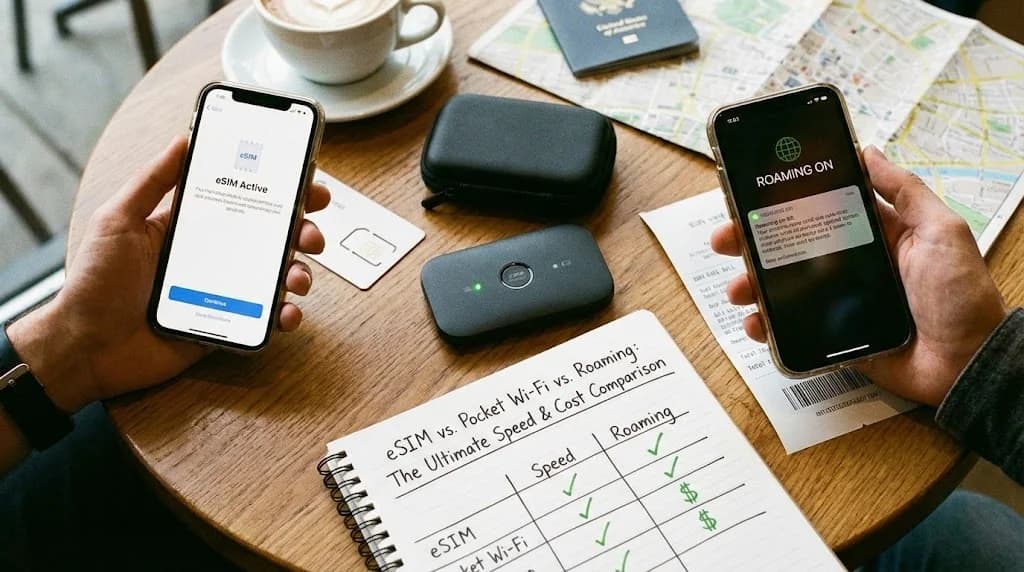
You’ve just landed. The cabin lights flick on, you unbuckle your seatbelt, and the first thing you grab is your phone. You need to find your hotel address, let family know you’ve arrived, or maybe just order a ride. But then you see it: “No Service.” It’s that familiar, small modern-day panic. Suddenly, your connection to the world feels a million miles away. This is exactly why figuring out your internet situation abroad is so important. For years, travelers have argued over eSIM vs. pocket Wi-Fi vs. roaming, each promising to be the best. We’re here to give you the real scoop, cutting through the marketing speak to help you pick the right option. This guide will show you how to avoid those nasty roaming charges and stay connected on your next trip.
- The Devil You Know: International Roaming Explained
- How Much Data Do You Truly Need for Your Trip?
- The Group Favorite: Pocket Wi-Fi Unpacked
- The Modern Solution: What Exactly is a Travel eSIM?
- Activating Your Cellesim eSIM: A Simple Guide
- The Main Event: eSIM vs. Pocket Wi-Fi vs. Roaming Comparison Table
- Beyond the Basics: Advanced eSIM Benefits
- Network Performance and Reliability with Cellesim
- Making the Final Call: Your Travel Style Matters
- Frequently Asked Questions
Stay Connected Across Europe
Explore 42 countries with a single Cellesim eSIM. Affordable, high-speed data for your adventures.
Shop Europe eSIM Plans 🌍
The Devil You Know: International Roaming Explained
International roaming is the easy button for many travelers. You land, turn off airplane mode, and your phone just works. Your home phone company has deals with networks in the country you're visiting, letting your phone connect to their service. But this convenience comes with a famously high price tag, leading to countless nightmare stories of phone bills in the thousands.
The Real Cost of Convenience
Phone companies often reel you in with "daily travel passes" that seem reasonable at first, maybe $10 or $15 a day. While that might be okay for a quick weekend, it adds up ridiculously fast on a one or two-week trip. A 14-day vacation could easily cost you an extra $140-$210 just to use your data. Even worse are the pay-per-megabyte rates if you don't buy a pass, where simply checking a few websites can cost you as much as a nice dinner. Roaming is only the cheapest option for data overseas if your trip is under 48 hours and you use very little data. You can see how much you might be overpaying by using a roaming savings calculator to compare these costs against better alternatives.
The Hidden Catch: Throttled Speeds
Beyond the cost, there's another dirty secret about roaming: slow speeds. To keep their own costs down with foreign partners, your home carrier might cap your data speed once you use a certain amount each day. You might start the day with decent 4G, but after a few Instagram stories and using Google Maps, you could find your speed cut down to sluggish 3G or even 2G, making most modern apps unusable. This is incredibly frustrating when you're trying to find your way in a new city or make a video call home.
How Much Data Do You Truly Need for Your Trip?
Before you pick a way to connect, it's really important to know how much data you actually use. Many travelers guess wrong, either overestimating what they need or forgetting how much data certain apps chew through. A typical travel day might include checking maps, scrolling social media, sending messages, and a few video calls. Here’s a breakdown to help you figure out your needs:
- Light User (1-2 GB per week): You mostly use Wi-Fi and only switch to mobile data for essential things like navigation, messaging (WhatsApp, iMessage), and quick email checks. You avoid streaming video or heavy social media use.
- Moderate User (3-5 GB per week): You use data for maps, frequent social media updates, some video calls, a bit of music streaming, and regular messaging. You still look for Wi-Fi for big downloads or long video sessions.
- Heavy User (7-10+ GB per week): You stream video often, make lots of video calls, upload high-quality photos, use your phone as a hotspot for other devices, and rely heavily on cloud services. You need fast internet all the time.
For most vacationers on a one or two-week trip, 5-10 GB of data is usually plenty. Business travelers or digital nomads might need more. Consider using Cellesim's Smart Data Calculator to estimate your specific needs based on your travel plans.
The Group Favorite: Pocket Wi-Fi Unpacked
For years, portable Wi-Fi devices, or pocket Wi-Fi, were the go-to for smart travelers trying to avoid roaming charges. It’s a small, battery-powered gadget that acts like your home Wi-Fi router, but you can take it anywhere. Inside, it has a local SIM card and broadcasts a secure Wi-Fi signal that you and your travel buddies can connect to. It’s a popular choice for families or groups traveling together.
The Burden of Extra Hardware
The main draw of a pocket Wi-Fi is connecting several devices to one source. However, this comes with some big practical downsides. First, it’s yet another device you have to rent, pick up, carry, and remember to charge. The battery life can be a constant worry; if it dies mid-day, your whole group loses internet. Second, there’s the hassle of getting it and giving it back. You either have to find a rental counter at the airport (often after a long flight) or arrange for it to be sent to your hotel, and then you must remember to mail it back before you leave to avoid late fees. And if you lose or damage it? The replacement fees can be huge, often more than $200.
Tethered to the Group
While a pocket Wi-Fi is great for keeping a family connected at a hotel or an Airbnb, it creates a "digital leash." If one person wants to visit a museum while another explores a market, someone will be without internet. This lack of freedom can be a real problem, forcing a group to stay together or leaving someone disconnected. It's a classic example of a travel solution that sounds good on paper but can be inconvenient in real life, unlike an eSIM, which gives everyone their own connection and flexibility. Find more practical connectivity solutions in our guide on the best eSIM for international travel.
The Modern Solution: What Exactly is a Travel eSIM?
Here comes the eSIM (embedded SIM). This is a game-changer for international travel. An eSIM is a digital SIM card built right into your smartphone (most models from 2018 onwards have one). Instead of physically swapping a tiny plastic card, you just download a data plan for your destination directly to your phone. You can buy it online before you even leave home and activate it the moment you land. This technology is quickly becoming the standard, with big phone makers like Apple and Samsung embracing it. For more technical details, you can check out resources from industry groups like the GSMA.
Unbeatable Convenience and Flexibility
The beauty of a travel eSIM is how effortlessly it works. You can buy a plan for Spain while waiting to board your flight in New York. When you land in Madrid, you just switch to your eSIM profile in your phone’s settings, and you're instantly online, connected to a top local network. No extra gadgets to carry, no batteries to charge, and no kiosks to hunt for. Your physical SIM card stays in your phone, so you can still get calls and texts on your usual number (if you want), while using the eSIM for affordable, fast data. Before you start, it's always smart to check if anyone in your group has eSIM compatible devices.
Superior Cost and Control
Cellesim eSIM plans are usually much cheaper than roaming and very competitive with pocket Wi-Fi, especially for solo travelers or couples. You buy a specific amount of data for a set time (e.g., 10GB for 30 days), giving you total clarity and control over your spending. There are no hidden fees or extra charges. If you run out of data, you can easily top up through an app. This model offers the best international data plan for most travelers today. For a detailed guide on managing multiple eSIMs, especially useful for trips across several countries, read our article on managing multiple eSIMs for a Eurotrip.
Activating Your Cellesim eSIM: A Simple Guide
One of the best things about an eSIM is how easy it is to set up. Cellesim makes this process simple, so you can get online quickly and without any fuss. Here’s a quick rundown of the steps:
- Purchase Your eSIM: Visit cellesim.com and pick a plan that fits your destination and data needs. You’ll get an email with your eSIM QR code or manual activation details right away.
- Install the eSIM:
- iPhone: Go to Settings > Cellular > Add eSIM. Scan the QR code or type in the details manually.
- Android: Go to Settings > Network & Internet > SIMs > Add eSIM. Scan the QR code or type in the details manually.
- Configure Data Usage: In your phone's settings, set your Cellesim eSIM to be your main line for cellular data. If you want, keep your home SIM active for calls and texts, but make sure to turn off data roaming for your physical SIM to avoid charges.
- Activate on Arrival: Once you land at your destination, just turn on your Cellesim eSIM line in your phone settings. Your phone will automatically connect to the best local network.
For a more detailed, step-by-step visual guide, check out our Interactive Setup Guide. It covers different devices and common troubleshooting tips, helping you start your trip smoothly.
Find Your eSIM Plan Now
The Main Event: eSIM vs. Pocket Wi-Fi vs. Roaming Comparison Table
To make your decision perfectly clear, let's stack up the main differences in a direct comparison. We've focused on the five factors most important to travelers: cost, speed, convenience, security, and who each option is best for.
| Feature | eSIM | Pocket Wi-Fi | International Roaming |
|---|---|---|---|
| Cost | Low to moderate. Pay-per-plan (e.g., $15 for 5GB). Very transparent. | Moderate. Daily rental fee ($8-$15/day) plus potential deposit and insurance. Risk of high loss/damage fees. | Very High. Daily passes ($10-$15/day) or exorbitant pay-per-MB rates. High risk of bill shock. |
| Speed | Excellent. Connects directly to top local 4G/5G networks. No throttling on most plans. | Good to Excellent. Also uses local 4G networks, but speed is shared among all connected devices. | Variable to Poor. Often subject to speed throttling by your home carrier after a daily limit is reached. |
| Convenience | Highest. Instant digital delivery. No extra hardware. Activate on arrival. | Low. Requires rental, pickup, return. Another device to carry and charge. | High. Works automatically upon landing. No setup required. |
| Security | High. Your own private, secure cellular connection. | High. A private, password-protected Wi-Fi network. | High. A private, secure cellular connection. |
| Best For | Solo travelers, couples, digital nomads, and anyone valuing cost, flexibility, and convenience. | Large groups or families staying together who need to connect multiple devices like laptops and tablets. | Very short business trips (1-2 days) where convenience outweighs the high cost, or for emergencies. |
As the table shows, while roaming is simple and pocket Wi-Fi works for groups, the eSIM stands out as the best global data plan for most modern travelers. It hits that sweet spot of affordability, strong performance, and unbeatable convenience. The speed is especially worth noting; an eSIM connects you to the same robust local networks as a physical SIM, a fact backed up by many eSIM speed tests in cities worldwide, which often show performance meeting or even exceeding expectations.
Beyond the Basics: Advanced eSIM Benefits
The advantages of eSIM technology go further than just cost and convenience. Its digital nature opens up many possibilities that old-school SIM cards or pocket Wi-Fi devices simply can’t offer, especially for smart travelers.
Dual SIM Functionality
One of the biggest perks is dual SIM capability. This means you can keep your main physical SIM card active for calls and texts from your home number while using your eSIM for data at the same time. You won't miss important calls or messages, and friends and family can still reach you on your familiar number, all while you enjoy affordable, fast local data. This feature is vital for balancing personal and work communication abroad, and it lets you keep your WhatsApp number even when using a travel eSIM.
Enhanced Security and Privacy
Unlike public Wi-Fi networks in airports, cafes, or hotels, an eSIM gives you a secure, private cellular connection. This greatly lowers your risk of data theft or cyber-attacks that can happen on unsecured public networks. Your data travels through the local carrier's secure system, giving you peace of mind when you're doing banking, checking emails, or handling personal info while traveling.
Environmental Friendliness
Because eSIMs are digital, they help reduce plastic waste. There are no physical SIM cards to make, package, and throw away. For travelers who care about the environment, choosing an eSIM fits right in with sustainable travel.
Instant Switching Between Plans
If your travel plans change or you run out of data, an eSIM offers instant flexibility. You can buy a new plan for a different country or top up your current plan in minutes, directly from your phone. This means no hunting for local SIM card shops or dealing with rental companies, saving you precious travel time and stress. Keep this flexibility in mind when planning for short vs. long trips to ensure you always have the best connection.
Network Performance and Reliability with Cellesim
A common worry when thinking about international connectivity is how good and reliable the network will be. With Cellesim eSIMs, you connect directly to the best local networks in your destination, giving you strong 4G and 5G speeds where available. Our partnerships with leading carriers worldwide mean you get the same high-quality service as local residents.
4G and 5G Availability
In most developed areas and major cities globally, Cellesim plans offer access to fast 4G LTE. As 5G networks keep growing, many of our eSIMs also provide 5G connectivity, which means incredibly fast downloads, smooth streaming, and quick browsing. This is a big step up from the often-slowed-down speeds you get with international roaming, and generally more consistent than a pocket Wi-Fi device that might rely on just one carrier’s physical SIM.
Extensive Coverage
Cellesim covers over 200 countries and regions. This wide reach ensures that whether you're exploring the busy streets of Seoul or the historic sites of Rome, you’ll have a dependable connection. Our network smartly picks the strongest signal, reducing dead zones and keeping you connected where it matters most. For example, traveling through Europe, you can move between countries like Spain and Germany without losing connection, thanks to regional plans like our Europe eSIM for 42 Countries.
Support When You Need It
Even the best technology can sometimes need a little help. Cellesim offers dedicated customer support via email at [email protected], making sure any connectivity issues or questions you have are answered quickly, no matter where you are in the world.

Making the Final Call: Your Travel Style Matters
The best travel internet choice really depends on what you need. Let’s look at a few common travel situations:
The Solo Backpacker in Southeast Asia
For a solo traveler hopping between Thailand, Vietnam, and Cambodia, an eSIM is a no-brainer. They can buy a regional Asia eSIM and enjoy continuous connectivity across borders without ever switching a physical SIM card. It’s light, affordable, and gives them the freedom to navigate, book hostels, and stay in touch on their own terms. Carrying and charging a pocket Wi-Fi would just be an extra hassle.
The Family on a Two-Week European Vacation
Here, the choice isn't so simple. A pocket Wi-Fi could keep the kids’ tablets online in the car and at the hotel. However, if the parents decide to split up for an afternoon, one person is left without internet. A more flexible approach might be an eSIM for each parent, giving them individual connectivity while still allowing them to hotspot a child's device if needed. This offers both freedom and shared access, making it a better choice for family travel with eSIM.
The Business Traveler on a Short Trip
For a business professional who needs to be constantly online for emails, video calls, and presentations, an eSIM provides reliability without the extra bulk of a pocket Wi-Fi. It works seamlessly with existing devices and ensures instant connectivity upon landing, which is crucial for tight schedules. While roaming might offer immediate access, the cost savings and consistent speed of an eSIM for business travelers are clear benefits for anything more than a single-day trip. Our guide on eSIM for constant connectivity offers more insights.
The Digital Nomad Exploring South Korea
A digital nomad needs reliable, high-speed internet for work and play. An eSIM for a specific country like South Korea, along with potential regional plans for future travel, gives them the ultimate flexibility and cost control. Unlike pocket Wi-Fi, there’s no need to worry about rental periods or return logistics, allowing for spontaneous changes to travel plans. Cellesim offers a strong alternative to traditional pocket Wi-Fi solutions, as shown in our comparison of Cellesim vs. Pocket Wi-Fi in Korea.
Frequently Asked Questions
Can I use my regular phone number with an eSIM?
Yes, absolutely. One of the main benefits of eSIM technology is its dual SIM function. You can keep your physical SIM card active in your phone to receive calls and texts on your home number, while using your Cellesim eSIM for all your data needs. This means you stay connected to your contacts without racking up expensive roaming data charges.
How do Cellesim eSIM speeds compare to local SIM cards?
Cellesim eSIMs connect you directly to the top local 4G and 5G networks in your destination country, just like a physical local SIM card would. This means you get the same fast speeds and dependable coverage as someone living there, often much better than the throttled international roaming speeds and sometimes more consistent than a pocket Wi-Fi device that relies on a single connection.
Is an eSIM secure for online banking and sensitive activities?
Yes, an eSIM provides a secure and private cellular connection. Unlike public Wi-Fi networks, which can be vulnerable, your Cellesim eSIM uses the strong and encrypted infrastructure of local mobile networks. This makes it a much safer choice for accessing sensitive information, doing online banking, or sending confidential emails compared to unsecured public Wi-Fi hotspots.
What happens if I run out of data on my Cellesim eSIM?
If you use up all the data on your Cellesim eSIM plan, your internet connection will stop. However, topping up is easy and fast. You can simply buy more data directly through the Cellesim website or app, and your new data plan will be active almost instantly, getting you back online without delay or fuss.
Are all smartphones compatible with eSIMs?
Most modern smartphones released from 2018 onwards work with eSIMs, including popular models from Apple (iPhone XS and newer), Samsung (Galaxy S20 and newer), Google (Pixel 3 and newer), and many others. It's always a good idea to check our eSIM compatible devices list on the Cellesim website to confirm your specific phone model before buying a plan.
When should I activate my Cellesim eSIM?
You can buy and install your Cellesim eSIM anytime before your trip, even before you leave home. However, it’s generally best to activate the data plan (turn on the eSIM line) once you’ve landed at your destination. This makes sure your data validity period starts when you actually need it, getting the most value from your plan the moment you step off the plane.
Ready for Seamless Travel Connectivity?
Forget the stress of huge roaming bills and unreliable Wi-Fi. Cellesim connects you instantly in over 200 countries.
Explore Cellesim eSIM PlansJoin 50,000+ happy customers who trust Cellesim for their global connectivity.